AI Can't Teach You BJJ
10 Feb 2026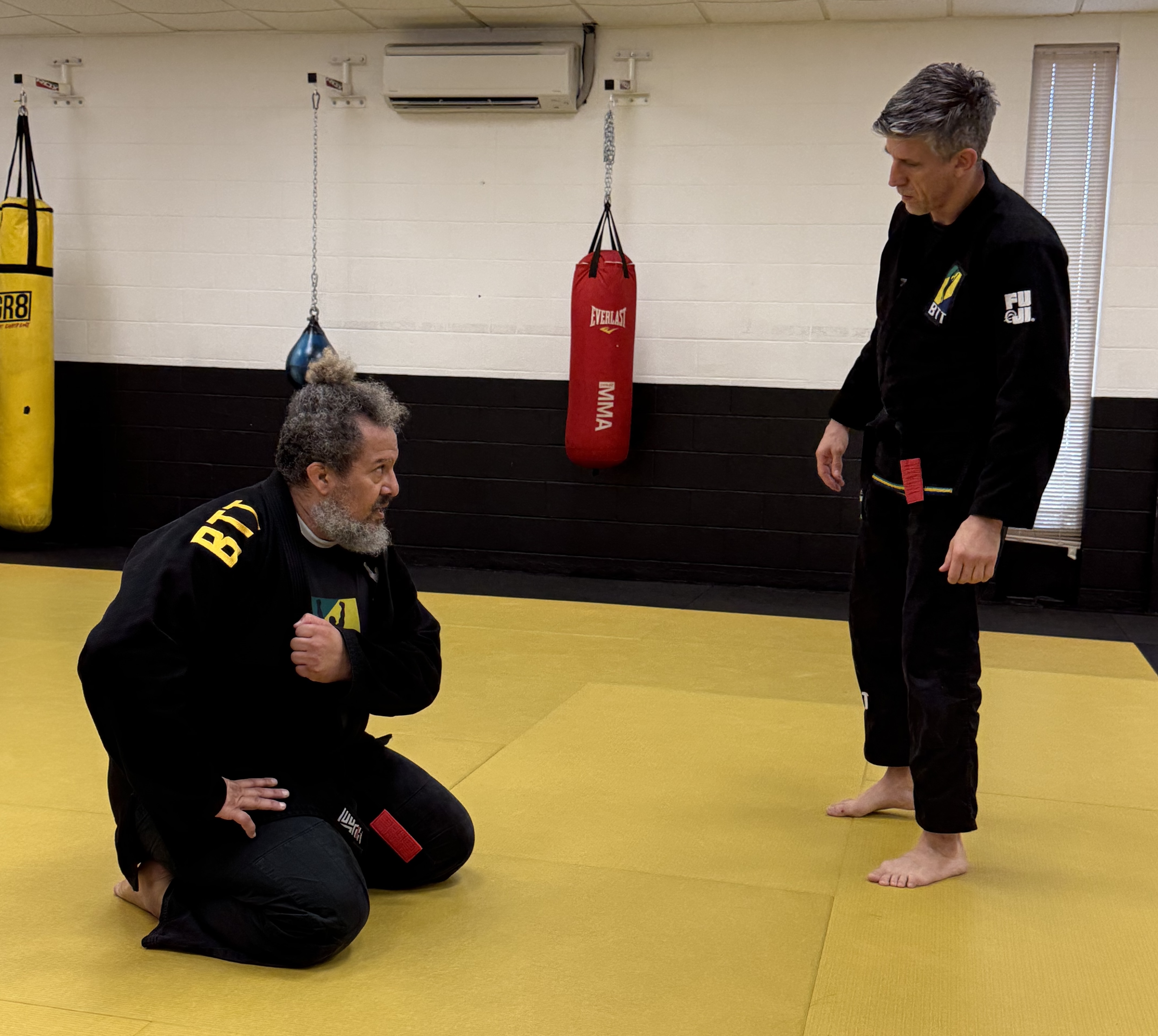
AI Can’t Teach You BJJ (And It Can’t Teach You to Code Either)
There’s a moment every Brazilian Jiu-Jitsu practitioner knows well. You’ve watched the instructional video. You’ve studied the technique. You understand, intellectually, exactly what you’re supposed to do. Then you roll with a live partner and your mind goes blank, your body forgets everything, and you get submitted in thirty seconds.
No amount of watching, reading, or theorizing prepared you for the actual experience of another human being trying to choke you. The gap between knowing about something and truly knowing it core tenet of progression in BJJ. It turns out it’s also the central truth of software engineering. And it’s exactly why AI, for all its remarkable capabilities, cannot teach you either one.
A Brief History of the Art
BJJ traces its roots to Judo, which was brought to Brazil in the early twentieth century by Mitsuyo Maeda. The Gracie family took what they learned and evolved it into something distinct: a system built around ground fighting, leverage, and the idea that a smaller, weaker person could defeat a larger, stronger one through technique and timing. Modern BJJ is now practiced by millions worldwide and forms the backbone of competitive MMA.
What makes it unique isn’t just the techniques. It’s the culture of learning. You don’t just study BJJ. You roll. You spar with resisting partners, get tapped out, figure out what went wrong, and go again. The mat is the classroom, and the feedback is immediate and unambiguous.
The belt system reflects this reality. Each rank, be it white, blue, purple, brown, or black, represents mat time, not just technical knowledge. A blue belt typically takes one to three years. Black belt? Often a decade or more. There are no shortcuts, and anyone who tells you otherwise has never been submitted by someone half their size.
So Why Can’t AI Teach You BJJ?
Ask an AI assistant about the closed guard, the triangle choke, or the berimbolo, and you’ll get a technically accurate, well-organized answer. It will describe the positions correctly. It will explain the mechanics. It may even cite respected practitioners.
But here’s the thing: the AI has never done BJJ. It has no body. It has never felt the weight of someone on top of it, never experienced the instinctive panic of a choke tightening around its neck, never had to override its own survival instincts to execute a technique under pressure. It can tell you what other people have said about BJJ. It cannot tell you what BJJ feels like because it doesn’t know.
This isn’t a subtle limitation. It’s a fundamental one. An LLM is a sophisticated pattern-matcher over human-generated text. It can reproduce the language of expertise without possessing the thing itself. The map is not the territory.
AI in Engineering: The Same Problem, Different Gi
Here’s where this gets interesting for anyone in tech.
AI coding tools are genuinely impressive. They can generate working code quickly, explain concepts clearly, suggest refactors, and catch common bugs. Used well, they’re a real productivity multiplier. Nobody serious is arguing otherwise.
But there’s a pattern emerging that should concern anyone who cares about the long-term health of the engineering profession: people using AI to produce code they don’t actually understand.
This is what I call “Instagram Jiu-Jitsu.” Instagram jiu-jitsu describes techniques that are flashy, complex moves that look spectacular in a video but collapse the moment they meet a resisting opponent. They’re built on aesthetics, not fundamentals. They work against beginners who don’t know how to counter them, and nowhere else.
“Vibe coding”, or generating AI code without understanding what it does, is the software equivalent. The code looks right. It might even run. But when something breaks in production, when requirements change, when you need to debug a subtle interaction between systems, the person who generated the code without understanding it has nothing to stand on. They can’t adapt. They can’t diagnose. They can’t build on it.
The fundamental difference between winning and getting good applies here too. Winning means hitting your metrics today: shipping the feature, passing the test, satisfying the immediate requirement. Getting good means developing the kind of deep understanding that compounds over time, that transfers to new problems, that makes you better tomorrow than you are today. AI can help you win. It cannot make you good.
The Belt Progression Nobody Talks About
Career progression in software engineering mirrors belt progression in BJJ more closely than most people realize.
A junior engineer, like a white belt, is learning the fundamentals: how to write clean code, how to read someone else’s, how to debug, how to ship. The work is supervised. The feedback is direct. The goal is survival and foundation-building.
A senior engineer has internalized those fundamentals and can now operate independently. They own features, mentor others, make architectural decisions within a defined scope. This is the blue or purple belt: someone with genuine capability who is starting to develop their own game.
A principal or staff engineer operates at a different level entirely. They shape technical direction across teams, understand the business deeply enough to connect technical decisions to outcomes, and multiply the effectiveness of everyone around them. This is the black belt and it takes time. It cannot be shortcut.
What’s often left out of career development conversations is just how holistic this progression needs to be.
Technical skills are the obvious ones: programming languages, cloud platforms, Kubernetes, DevOps practices, SRE, observability. These are your techniques: the submissions, the guard passes, the escapes.
But business knowledge depth matters just as much. Having an understanding business processes, project and program management, change management, incident management, cost optimization is what separate engineers who ship features from engineers who build systems that last and organizations that function.
And then there are professional skills: crafting a resume that tells your story, interviewing well on both sides of the table, giving and receiving meaningful feedback, mentoring others effectively. These are often treated as soft or secondary. They’re not. At senior levels, they’re often the primary leverage point.
AI can help you with any of these in the moment. It cannot build any of them for you over time.
There Are No Shortcuts to the Black Belt
Here is the uncomfortable truth that both BJJ and software engineering keep teaching, over and over: genuine expertise is the product of experience, and experience cannot be transferred or shortcut.
You must get on the mat. In engineering, that means writing code that breaks in production and figuring out why. It means working through a bad architectural decision and cleaning it up. It means sitting in a meeting where the business wants something technically dangerous and learning how to push back constructively. It means failing, recovering, and building judgment from the residue of both.
Failure is not the enemy of learning. It is learning. Every submission in BJJ is information. Every outage, every failed deploy, every project that overran budget and/or timelines is information too. The engineers who treat these as shameful events to be minimized are the ones who stop growing. The ones who treat them as data get better.
Seek out mentors. A good coach in BJJ doesn’t just show you techniques. They watch you roll and see the things you can’t see about yourself. A great senior engineer does the same thing. They notice the patterns in how you approach problems, the gaps between what you think you’re doing and what you’re actually doing. This kind of feedback is irreplaceable.
Engage with community. Your training partners are not obstacles. They’re the primary mechanism through which you get better. The engineering community, whether in your organization, at conferences, or in the discourse online, serves the same function. Isolation makes you stagnate.
And above all: focus on getting good, not just on winning. The engineers who thrive over a career are the ones who stay curious, who seek out hard problems on purpose, who drill their weaknesses rather than reinforcing their strengths. They are the ones who, when AI changes the nature of the work (again) are able to adapt, because their expertise is real.
On AI as a Tool
None of this is an argument against using AI. AI is a remarkable tool, and refusing to use it out of principle is its own kind of foolishness.
But dependency on something you don’t control is a mistake. If you can only do your job because an AI is doing it for you, you haven’t developed the capability, you’ve rented it. And what you rent can be taken away, changed, or simply fail at the worst possible moment.
Use AI to move faster through things you already understand. Use it to explore unfamiliar territory more efficiently. Use it as a second set of eyes on your work. But make sure you understand what it’s producing. Make sure you’re building judgment, not just output.
The goal is to be the kind of engineer who uses powerful tools well, not one who is dependent on them to function at all.
The Takeaway
There are no shortcuts to the black belt. Not in BJJ, not in software engineering, not in any craft worth pursuing.
AI is changing the nature of both fields in ways we’re still figuring out. Some of what it changes is genuinely good. Some of it creates new risks, especially for early-career practitioners who may be tempted to skip the fundamentals that later expertise is built on.
The answer isn’t to resist the tools. It’s to be clear-eyed about what they can and cannot do.
They can generate. They cannot understand. They can accelerate. They cannot replace the years of deliberate practice, failure, mentorship, and community that turn someone into a genuine expert.
Get on the mat. Break things. Learn from them. Find good training partners and coaches. Show up consistently.
That’s how you get your black belt.